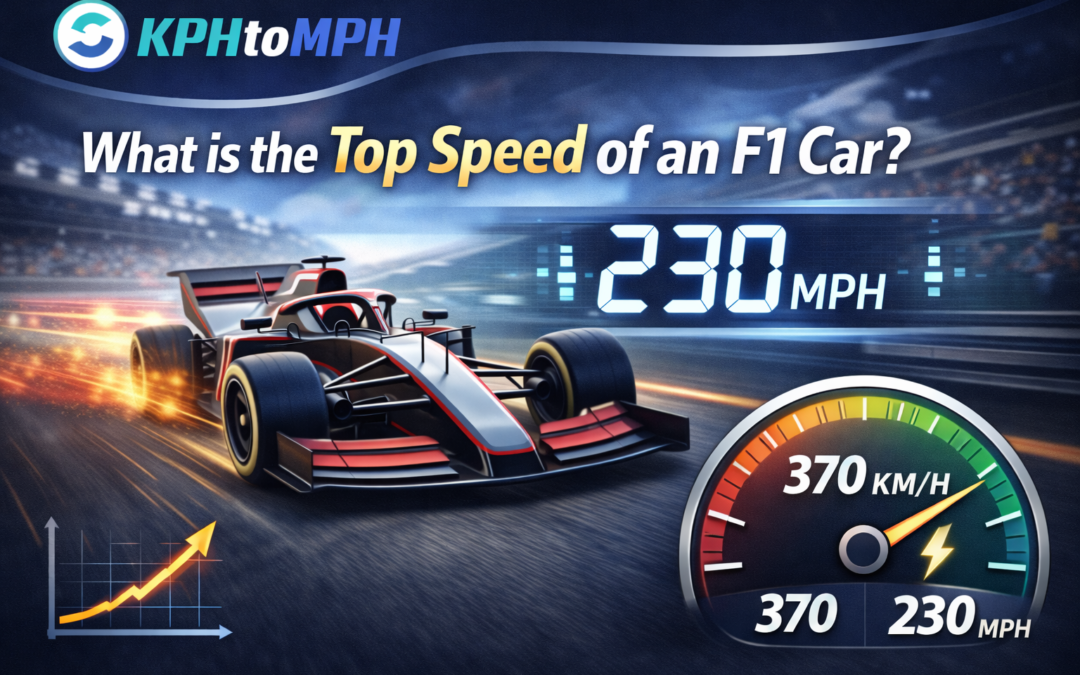
You see wild speed claims about Formula 1, but the correct number depends on track layout, car setup, weather, track grip, and how the speed was recorded. In normal race trim, modern F1 cars regularly clear 220 mph on the fastest circuits, yet qualifying tows, tailwinds, and low-fuel runs can push the peak higher for a single lap.
In this guide, you will get credible mph and km/h ranges, learn what counts as verified, and know exactly how to judge any “top speed” number you see online today.
The most accurate top speed range in modern F1
If you want the answer that fits what you watch on a Grand Prix weekend, expect modern F1 cars to exceed 220 mph on long, low-drag straights. On speed-focused tracks like Monza, recent examples land in the low-220s mph range, which is why “over 220 mph” is a safe modern baseline. When you ask what is the top speed of an F1 car, this race-weekend band is the number you can actually use.
Top speed is not a fixed specification because teams tune for lap time, not for a single headline. More downforce helps you brake later and carry more speed through corners, but it also adds drag that lowers the end-of-straight peak. That tradeoff explains why the same car can look “slow” on one circuit and “fast” on another without any fundamental change in power.
You also need to separate “one-lap peak” from “highest speed seen all weekend.” A car can hit its biggest number in qualifying with low fuel, fresh tires, and an ideal tow, then run slightly slower in the race with heavier fuel and different energy targets. When you keep that distinction, you stop expecting one magic number to appear in every session.
Verified extremes vs race-trim peaks
Race-trim peaks can jump into the 230s mph range when you combine a long straight, a low-drag setup, and a strong tow. A classic example comes from Baku 2016, where a qualifying slipstream helped produce a peak around the mid-230s mph. That number is real, but you should treat it as an outlier created by conditions you do not get every weekend.
If you want the highest verified F1-related figure, you need to look at special runs that strip away drag and chase pure speed. One independently verified high-speed effort with an F1-based car reached roughly 247 mph, which sits well beyond normal racing configuration. This is why you should always ask whether a claim refers to a race session, a test, or a modified car built for a speed record.
Why the same car shows different speed at different tracks
Track design decides whether top speed matters more than cornering, and that shapes the setup you see. A circuit with long straights rewards low drag, so teams flatten wings and accept less grip in medium-speed turns. A circuit packed with slow corners rewards traction and stability, so teams add downforce even though it lowers the speed trap.
Wind and elevation can change the result more than most people expect. A tailwind can lift the speed trap by a few mph, while a headwind can erase the gains of a low-drag setup. Even the length of the straight matters because some cars reach peak speed earlier, while others need more runway to hit their ceiling.
Corner type also matters because it decides how you enter the straight. If the straight follows a slow corner, traction and clean power delivery can matter more than ultimate drag, because you spend more time accelerating. If the straight follows a fast corner, the car starts the straight already moving quickly, so aero efficiency tends to dominate the final number.
Power units, ERS, and sustained speed
Modern F1 uses a 1.6L turbocharged V6 paired with an energy recovery system, and combined output is often described as over 1,000 horsepower. For top speed, the key is not only peak power but how long you can sustain electrical deployment down the straight. If your battery support fades early, you will arrive at the speed trap with less push and a lower number.
ERS strategy is also a decision-making system that you feel in the data. Teams choose where to harvest and where to deploy based on overtaking zones, tire life, and traffic. That is why you can see one lap with a brilliant exit but a weaker peak, and another lap with a slightly slower exit that still posts a bigger top speed.
Aerodynamics and the downforce vs drag bargain
F1 cars win races by being absurdly fast in corners, and that comes from downforce. Downforce pushes the tires into the track so you can brake harder and turn faster without adding mass. The catch is drag, and drag is what limits how quickly you can cut through the air at the end of a straight.
Small aero tweaks can change top speed in a way you can measure. More wing angle increases grip and confidence but costs mph, while trimming the wing reduces drag but can hurt tire management and braking stability. This is also why you should not compare two top speeds unless the cars run similar wing levels and similar straight lengths.
How low-drag packages create headline numbers
On low-downforce weekends, teams reduce wing and streamline bodywork choices to cut drag, and the car punches a cleaner hole through the air. You often gain a few mph, but you also lose some stability in braking zones and medium-speed corners, so you must drive more precisely to keep lap time. That is why the fastest trap does not always belong to the fastest car over an entire lap.
Acceleration: what matters more than 0 to 60
You will hear 0 to 60 mph figures around the low-2-second range for modern F1, but those numbers depend heavily on traction and launch conditions. A road car test uses standardized surfaces and procedures, while an F1 start depends on clutch bite, tire temperature, and track grip. That is why you should treat any single 0 to 60 claim as approximate rather than a universal fact.
Rolling acceleration is where F1 speed feels unreal and where lap time is won. Strong traction out of medium-speed corners and rapid gear-to-gear pull is what lets the car reach 300 km/h quickly on the straights. When you evaluate performance, you get more insight from sector times and exit speeds than from a single launch metric.
You can also think about acceleration as time spent near full throttle. If a setup gives you confidence and grip, you can apply power earlier, which can beat a higher theoretical top speed that you reach only at the very end of the straight. That is why lap time often rewards usable acceleration more than a peak number.
How to read speed traps without getting fooled
A speed trap is a snapshot at a fixed point, so it is sensitive to how you approach it. If you exit the previous corner poorly, you carry less speed onto the straight, and the trap looks slow even if the car is strong. If you get a tow, you reduce drag, and the trap looks fast even if the car did not gain real power.
To compare cars fairly, look for repeated traps across similar laps and conditions. If one car is consistently faster across multiple laps without heavy tow, you are seeing a real low-drag advantage or stronger sustained deployment. If the record appears once and never returns, the cause is often wind, tow, or a unique battery pattern.
Here are quick checks you can use before you trust a speed number:
- Confirm whether it came from race, qualifying, or a special run, because each scenario changes fuel, tires, and intent.
- Confirm whether the car had a tow or DRS, because reduced drag can add speed without changing the car’s base performance.
- Confirm the unit and the measurement point, because km/h and mph swaps create instant misinformation.
Tow, DRS, and timing effects
A tow works by reducing the air resistance you face, while DRS works by reducing wing drag, and both can lift the trap number even if power stays the same. Timing also matters because the trap is a single slice of the straight, not an average of your entire run. When you keep those factors in mind, you will understand why top speed varies even for the same driver on the same weekend.
Converting mph and km/h the right way
F1 broadcasts often use km/h while US readers default to mph, so unit mistakes are common. If someone throws out 350 km/h, that is about 217 mph, which sits right in the modern F1 conversation on fast tracks. Getting the units right is the fastest way to spot inflated claims that sound impressive but don’t add up.
If you want quick, clean conversions while you compare articles, a KPH to MPH converter helps you keep everything consistent without mental shortcuts. Consistency matters because small conversion errors can make a normal speed sound like a record. Once you convert correctly, you can compare sessions, tracks, and series without guessing.
Putting fast in context with real-world benchmarks
A number like 180 km/h can sound extreme, yet it is closer to highway speeds than to elite motorsport pace. When you translate it, 180 km/h is about 112 mph, which helps you see how far beyond normal driving F1 truly is. If you want a simple baseline that calibrates your intuition, is 180 km h fast gives you a grounded way to compare everyday speed to racing speed.
A more meaningful motorsport benchmark is 300 km/h because many F1 circuits push cars past it repeatedly. At 300 km/h you are around 186 mph, and you are already deep into the zone where aerodynamics and stability dominate the driving experience. When you want a reusable conversion anchor for that threshold, how fast is 300 km per hour gives you a clear frame you can apply to any race report.
The clearest answer you can confidently repeat
If you need one practical sentence, you can say modern F1 cars can exceed 220 mph in race conditions on the right track and setup. If you want to include the eye-catching highs, you can add that rare race-session peaks can reach the 230s mph, and verified special runs have approached the mid-240s mph range with modified low-drag configurations. That phrasing stays accurate, avoids myths, and explains why different articles quote different numbers.
When you read a new top speed claim, you can validate it in seconds. Check whether the number is mph or km/h, check whether it happened in race trim, and check whether tow or wind likely played a role. If you follow those checks, you will understand F1 speed with far more clarity than a single headline number can provide.
Conclusion
Your best answer depends on whether you mean race-trim reality or absolute capability, so you should always start by defining the context. For most fans and readers, the useful everyday range is that modern F1 cars often exceed 220 mph on the fastest tracks, while unusual combinations of low drag, strong deployment, and a tow can produce peaks in the 230s mph during qualifying or even in-race.
If you also want the outer limit, verified special runs with modified low-drag configurations have approached the mid-240s mph range, which proves the platform can go faster than it ever should in normal competition, and you can keep your interpretation accurate by checking units, setup, wind, and whether the measurement came from a comparable speed trap across multiple laps and sessions, without relying on hype or shaky clips online.