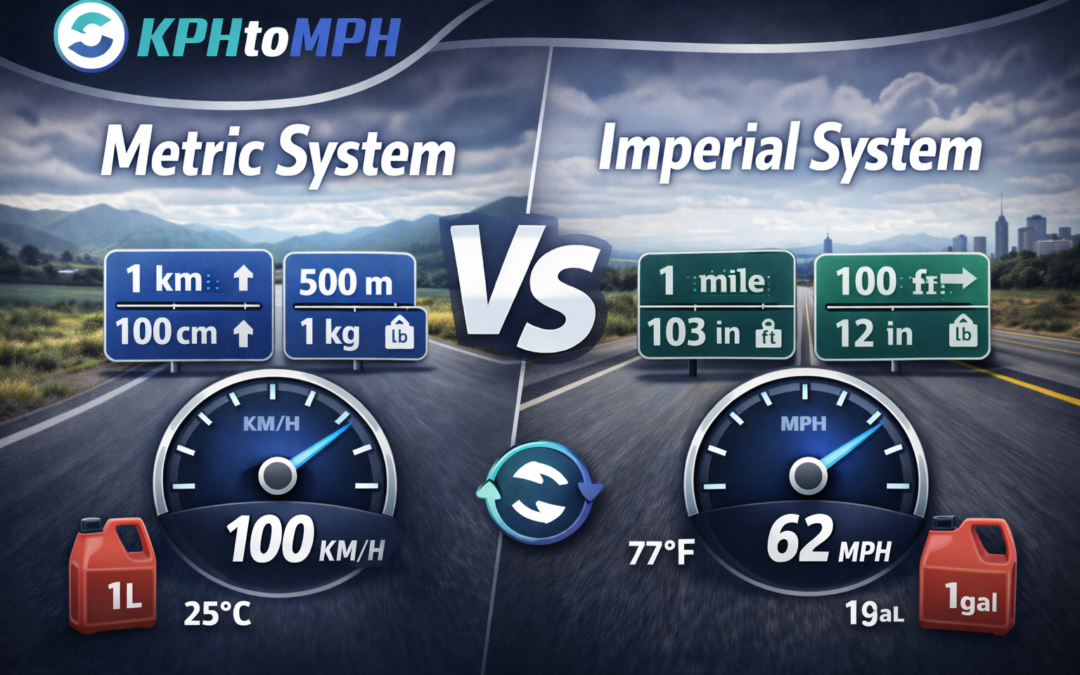
When you compare the metric vs imperial system, you are really deciding between two different ways of measuring your world.
In the United States, you use miles, pounds, and Fahrenheit daily, yet science, medicine, and global trade rely heavily on meters, kilograms, and Celsius. This difference often creates confusion, especially when you cook international recipes, travel abroad, or analyze technical data.
By understanding how each system works, why they exist, and when to use them, you gain clarity, confidence, and control over measurements in real-life decision-making. Read to learn more!
The Origins of the Metric vs Imperial System
The metric vs imperial system debate begins with history, and understanding that history helps you see why both systems still exist. The metric system emerged in France in 1795 as a standardized, base-10 system designed to eliminate regional inconsistencies and improve scientific accuracy. The imperial system, formalized in Britain in 1824, evolved from older English units that Americans continued using after independence, which explains why the United States still relies heavily on customary measurements.
When you examine historical adoption, you notice that most countries transitioned to metric during the 19th and 20th centuries to simplify global trade and industrial production. Today, over 95 percent of the world officially uses the metric system as its primary measurement framework. The United States remains one of only three countries that still use imperial units widely in daily life, alongside Liberia and Myanmar.
Core Units in Both Systems
To truly understand metric vs imperial system differences, you need to focus on the core units of length, mass, and temperature. In the metric system, you measure length in meters, mass in grams or kilograms, and temperature in Celsius. In the imperial system, you measure length in inches, feet, and miles, mass in ounces and pounds, and temperature in Fahrenheit.
The key distinction lies in structure, because metric follows a consistent base-10 format while imperial relies on varied conversion factors. For example, one kilometer equals 1,000 meters, but one mile equals 5,280 feet. This structural simplicity makes metric easier for large-scale calculations and scientific modeling.
Length: Miles, Kilometers, and Real-World Impact
Length measurements often create the most confusion for Americans comparing metric vs imperial system standards. When you drive in the United States, you measure distance in miles and speed in miles per hour, but most other countries use kilometers and kilometers per hour. If you want clarity on how these units relate in everyday contexts, reading about how many kilometers are in a mile through how many kilometers in a mile helps you visualize the 1.6-to-1 ratio in practical terms.
Understanding this relationship improves your travel planning and navigation skills abroad. For example, 100 kilometers equals roughly 62 miles, which gives you a fast mental benchmark when estimating travel time. With practice, you can convert between systems quickly without relying on constant calculator use.
Speed and Driving Conversions
Speed highlights the metric vs imperial system contrast more clearly than almost any other measurement. American highways use miles per hour, while Europe, Asia, and most of Africa use kilometers per hour on road signs. If you want a practical, reliable tool for converting vehicle speed, the KPH to MPH converter allows you to translate units instantly and avoid miscalculations when driving internationally.
Knowing speed differences also improves safety awareness. For example, 120 km per hour equals about 75 mph, which feels fast in any country. Accurate speed conversion supports confident decision-making when renting vehicles or interpreting global racing statistics.
Weight and Mass: Pounds vs Kilograms
When comparing metric vs imperial system weight measurements, you notice a clear difference in scaling logic. In metric, 1 kilogram equals 1,000 grams, creating a clean, predictable structure for scientific and medical use. In imperial measurements, 1 pound equals 16 ounces, which introduces irregular conversion factors that require memorization.
If you monitor your body weight or track fitness metrics internationally, you often convert between pounds and kilograms. One kilogram equals approximately 2.2 pounds, which means 70 kilograms equals about 154 pounds. This relationship becomes easier to remember once you repeatedly apply the 2.2 multiplier in real scenarios.
Temperature: Fahrenheit vs Celsius
Temperature differences in the metric vs imperial system affect daily weather reports and cooking instructions. The United States relies on Fahrenheit, where water freezes at 32 degrees and boils at 212 degrees. The metric system uses Celsius, where water freezes at 0 degrees and boils at 100 degrees, which reflects the base-10 logic of the system.
To convert Celsius to Fahrenheit, you multiply by nine, divide by five, and add 32, which may seem complex at first. However, you can remember anchor points such as 20 degrees Celsius equaling 68 degrees Fahrenheit. These benchmarks simplify mental conversion during travel or international communication.
Cooking and Baking Accuracy
In the kitchen, the metric vs imperial system debate becomes practical rather than theoretical. American recipes commonly use cups, tablespoons, and teaspoons, while metric recipes rely on grams and milliliters for precision. Because cup measurements can vary depending on ingredient density and packing style, weighing ingredients in grams produces more consistent baking results.
If you compare systems side by side, you notice that 1 cup equals 16 tablespoons and 8 fluid ounces in the imperial framework. Meanwhile, 1 liter equals 1,000 milliliters in metric, which simplifies scaling for large batches. Many professional chefs prefer metric for high-accuracy baking because precise gram measurements reduce variability.
Scientific and Global Standardization
Science overwhelmingly favors the metric system due to its universal standardization. The International System of Units defines base units such as the meter, kilogram, second, ampere, kelvin, mole, and candela to ensure global consistency. When researchers collaborate across borders, metric measurements eliminate confusion and prevent costly conversion errors.
One famous example of conversion error occurred in 1999 when a Mars spacecraft mission failed due to unit miscommunication between metric and imperial data. This incident demonstrated the financial and scientific risks of inconsistent measurement systems. As a result, global industries increasingly rely on metric for high-performance engineering and data accuracy.
Everyday Life in the United States
Despite global trends, the metric vs imperial system comparison remains relevant for American daily life. You still purchase gasoline by the gallon, measure height in feet and inches, and estimate road trips in miles. However, you encounter metric constantly in medicine, nutrition labels, and imported products, which means you already live in a hybrid measurement environment.
For example, track events, international sports statistics, and automotive specifications often list speeds in kilometers per hour. If you are curious about record-breaking athletic speeds, reading about Usain Bolt’s top sprint metrics through usain bolt top speed km h provides perspective on how elite performance translates between systems. This crossover illustrates how both systems coexist in American awareness.
Advantages and Disadvantages of Each System
When evaluating metric vs imperial system advantages, you should consider usability, familiarity, and precision. Metric offers logical base-10 conversions, easier large-scale calculations, and global compatibility. Imperial provides cultural familiarity, intuitive everyday references for Americans, and embedded usage in infrastructure.
From a decision-making standpoint, the best system often depends on context. If you conduct scientific research or manage international trade, metric delivers efficiency and clarity. If you measure home improvement materials or discuss weather in the United States, imperial feels natural and convenient.
Should the United States Fully Adopt Metric?
The question of full metric adoption remains politically and culturally complex. Although Congress legalized metric use in 1866, the United States never mandated nationwide conversion, partly due to infrastructure costs and industry resistance. Transitioning road signs, education systems, and manufacturing standards would require large-scale investment and coordinated policy action.
However, younger generations already learn metric in science classes and use it in digital technology contexts. Over time, gradual integration may continue without forcing a complete system replacement. For now, understanding both systems empowers you more than choosing sides in the debate.
Conclusion
The metric vs imperial system comparison affects your travel, cooking, science literacy, and everyday communication. While the metric system dominates globally due to its logical base-10 design and scientific precision, the imperial system remains deeply rooted in American culture and infrastructure.
By learning key conversion relationships for length, weight, speed, and temperature, you strengthen your practical measurement skills and reduce confusion in international contexts. Ultimately, mastery of both systems gives you flexibility, accuracy, and confidence, which matters more than loyalty to one framework.